




Inviting Butterflies to Your Landscape
June 22 - 28 is National Pollinator Week - a time to raise awareness about bees, butterflies and other animals that pollinate the plants in our ecosystems. Managing your landscape to support butterflies is not only a significant way to help protect these species that have been in decline in recent decades, but also to bring an added dimension of movement and beauty to your garden.

gardening for butterflies in western PA
Along with providing the service of pollinating plants in our region, butterflies are a critical element to local food webs. There are more than 700 butterfly and skipper species in North America, with more then 146 species found in Pennsylvania. Like moths, butterflies and skippers ( an intermediate form of insect between butterflies and moths ) belong in the very large order, Lepidoptera - meaning "scaled wing" because tiny dust-like scales make up the markings on butterflies that humans recognize. Some of these intricate markings can help the tiny creature to hide in its environment, while others wing markings, like "eyespots" and bright warning colors, can scare away predators.
support the unique butterfly lifecycle
The life of any butterfly is marked in four stages:
An EGG is laid by an adult. Most often, the adult butterfly will only lay their eggs on one or two species of "host plants" which their developing offspring can eat as soon as they emerge.
In the LARVA, or caterpillar stage, the creature grows larger and larger as it eats the leaves of the host plant, shedding its exoskeleton as many as six times.
After the final molt, the larva transforms into a PUPA which is surrounded by a hard protective coating called a chrysalis ( moths spin fibrous "cocoons" in this stage ).
In this stationary stage that often lasts 10 -14 days in the summer months, the insect undergoes metamorphosis - with body parts dissolving and reforming into an ADULT butterfly - the shape we most often recognize.
The emerging ADULT butterfly opens and dries its wings to harden them, and very soon is nectaring at the flowers in their habitat and seeking out a mate to begin the cycle once more.
Food, Shelter and Sunbathing Spots
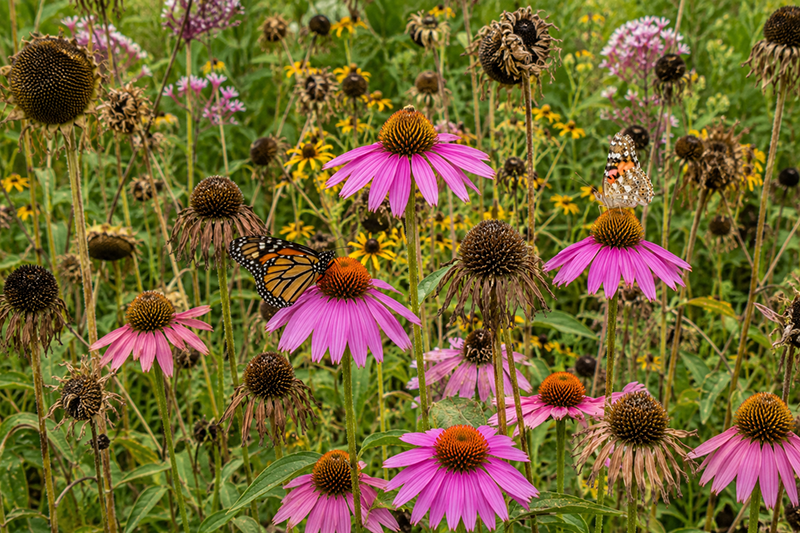
Most adult butterflies feed on nectar from a variety of plants, preferring native species and especially those that provide a "landing pad" such as coneflowers, joe pye and ironweed.
Here's some tips to attract adult butterflies to your yard:
Plant nectar-producing plants that bloom at various times, from late spring into fall.
Butterflies will find individual plants, tasting with receptors on their feet when they
land - but to make your environment especially attractive, arrange plants in larger groupings or "drifts".
Butterflies often use moist soil or mulch as "puddling" areas where they use their straw-like proboscis or feeding tube to suck up essential minerals that are not found in nectar alone.
Butterflies depend on their surroundings to become warm enough to fly; by including some "basking rocks" in your landscape you can provide a safe place for butterflies to warm up and then take flight.

Host plants for western pa caterpillars
But perhaps the most important thing that we can do is to provide some host plants for different types of adult butterflies to lay their eggs on. Many of us are now aware that the recognizable black and orange Monarch butterfly will only lay its eggs on species of milkweed or Asclepias plants such as Asclepias incarnata ( Swamp Milkweed ) , A. tuberosa
( Orange butterfly weed ) or the exceptionally sweet-smelling "common milkweed" ( A. syrica ). And beyond the monarch, there are many eye-catching local butterflies that we can support by thoughtfully including some of these host plants for developing caterpillars:
The orange and black Great Spangled Fritillary ( a brush-footed butterfly ) lays its eggs on common violets ( Viola species ), while the bright Baltimore butterfly lays its eggs on the shade loving turtlehead plant ( Chelone glabra ).
The trees and shrubs in your landscape and neighborhood are also valuable larval food sources. The Red-spotted Purple butterfly and Viceroy butterfly lay eggs on willow, cherry ( Prunus ) and oak tree leaves. The large yellow and black Tiger Swallowtail butterfly lay eggs on wild black cherry ( Prunus ) and birch trees.
You can also select shrubs that can host plants for developing larva: The striking black and indigo Spicebush Swallowtail lays eggs on sassafras and the native spicebush
( Lindera benzoin), while the tiny Spring Azure uses shrub dogwood shrubs for growing caterpillars.
Are you considering a pawpaw tree in your landscape? If you do, you may help to bring back the huge Zebra Swallowtail butterfly that is seldom seen in our area anymore due to habitat loss.
It is important to avoid over-pruning host plants during the breeding season.

Encouraging A LONGER STAY
And in keeping with the idea of supporting the lifecycle of these beautiful and essential pollinators, remember that although the Monarch butterfly migrates to warmer climates in the fall to escape the winter cold ( and lack of food ), most local butterflies overwinter as eggs or pupa to emerge when our plants once again burst into leaf - so consider leaving your stems up in your garden throughout the winter and leaves on your ground in areas of your landscape, so butterflies and a hosts of other living things can survive winter's dark and cold days.
Tell Us
Tell us how you celebrate National Pollinator week by visiting us on Facebook (moon township garden club) , Instagram (@moontwpgardenclub) or email us at info@moontownshipgardenclub.com - share in the conversation.


Comments